 https://youtu.be/q6XozWB7Uus
A great source for Yoga Postures by Mark Giubarelli.
YOGA POSTURES  ASANA YOGA POSES YOGA POSITIONS
Tadasana Downward Dog Cobra pose Headstand Shoulderstand Warrior 1 pose Warrior 2 pose Triangle pose Half Moon pose child pose Cat Pose

Yoga Positions – Parsvakonasana
Translation: Extended Side Angle Pose
From Tadasana step the legs apart. Turn one leg out and bend the knee over the ankle. From Uttanasana step one leg back and externally rotate it until the heel touches the mat. From the Downward Dog Pose step one leg forward between the hands. Externally rotate the back leg until the heel touches the mat.
Turn the foot of the back leg 90 degrees or slightly inward. Place one hand on the mat beside the bent knee and the other hand diagonally out. Stretch the side of the body. In easier versions of this pose the elbow can be placed on the bent leg or on a block.
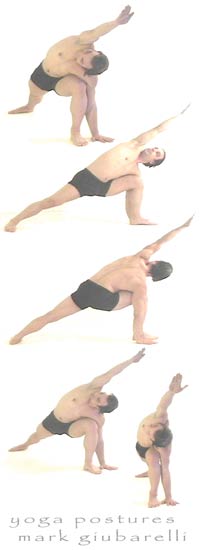
There are many theories of how this pose should be modified. The back foot does not come to the mat easily if the angle across the body is one clean line from the back legs to the extended arm and fingers, but it does look and feel good.
Common Faults
Both feet have a tendency to Evert (Pronate). This means that all the weight falls onto the inside of the feet. This happens especially in the back leg. Try to get the pinky toes to the mat. To do this you must engage the Tibialis posterior and Tibialisanterior.
Benefits
The extended side angle stretches the side of the body. However it is a pose that involves all the muscles in the body.
The Groin and shoulders are stretched. The muscles around the hip of the leading leg are stretched and toned. The gluteal muscles are toned and the muscles around the lateral lower abdomen are stretched. Toward the lower back the quadratus lumborum a big muscle that runs along the top of the pelvis and attaches to the bones in the spine is significantly stretched.
The shoulders muscles such as the rotator cuff and closer to the spine the rhomboideus major and minor get a good stretch. Muscles in the shoulders and neck are toned such as the upper trapezius muscles and the levator scapulae. Arm muscles are also toned. The latissimus dorsi is stretched. This is a big muscle that attaches to many bones in the spine (from the sacrum to the lower shoulders) and gathers beside the ribs to attach to the humerus.
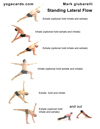
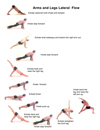
Practice yoga at home with a printable Home yoga flow showing this pose blended with other yoga poses.
See other yoga sequences that have Extended Side Angle Pose.
Muscles involved in the external hip rotation in the back leg are the quadratus femoris, gemellus superior and inferior, obturator internus and externus and the piriformis, they are all strengthened. When they are used the inner leg muscles in the back leg become stretched. They are the pectineus, adductor brevis, adductor magnus, gracilis tendon of the psoas major and further up the pelvis the iliacus on the outer part.
The Leg adductors are stretched in the back leg. Some of these are , the pectineus, adductor brevis and adductor longus, the gracilis and adductor magnus.
Vinyasa Yoga postures to transition from and to:


TadasanaVirabhadrasana 2 Urdhva Virabhadrasana 2 Virabhadrasana 3 Parivrtta Ardha Chandrasana Ardha Chandrasana Anjaneyasana Adho Mukha Svanasana Eka Pada Adho Muka Svanasana Utkatasana Uttanasana Vrksasana Trikonasana Parivrtta Trikonasana Revolved Lunge Virabhadrasana 1 Parsva Dandasana Parsvottanasana
Yoga Teacher Tips
This posture requires a flexible groin. Without it the knees has a tendency to turn in. When it is opened out the hip roles in. Therefore to master this work your own groin flexibility and the groin flexibility of the students.
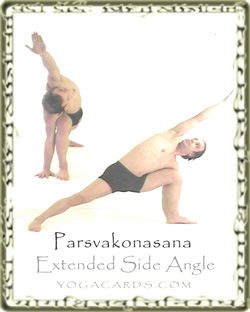
Sun Salutation with Parsvakonasana

Click to Enlarge Pic