YOGA POSTURES  ASANA YOGA POSES YOGA POSITIONS
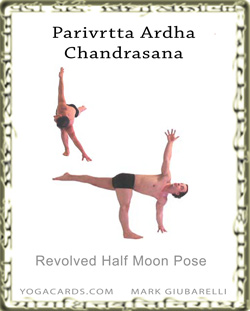
Parivrtta Ardha Chandrasana
Translation: Revolved Half Moon Pose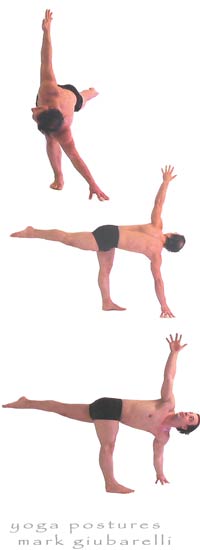

Place one hand on the mat in front of you and diagonally out. (If you are a beginner place both hands in front of you and use both. Make sure you are secure before using only one hand.)
Raise one leg up. (The leg on the same side as the supporting arm.)
Raise the back leg up and extend through the foot. Try to horizontally align the hips. The hamstrings need to be flexible.
Raise one arm up to create a rotation in the spine and gaze up at the hand.
Tips
This pose will strengthen the muscles necessary to perform Warrior 3. Try to visualize straight lines of energy moving through the arms and across the spine up through the foot behind you and the top of the head.
Benefits
The Reverse Half Moon pose will strengthen both legs and the lower back muscles on one side. The gluteus muscles on the side of the raised leg will become
stronger. The arms and shoulders become stronger and the muscles needed to rotate the spine become more flexible.
Vinyasa Yoga Sequencing and Flowing
Vinyasa Yoga postures to transition from and to:


Tadasana Trikonasana Parivrtta Trikonasana Virabhadrasana 1 Virabhadrasana 2 Urdhva Virabhadrasana 2 Parsvakonasana Revolved Lunge Utkatasana Uttanasana Vrksasana Virabhadrasana 3 Reverse Half Moon Pose Downward Dog Pose, Eka Pada Adho Muka Svanasana Parsvottanasana
This is a nice posture to enter after standing spinal twists. It blends very well in classes and students can learn with both hands on the mat until confidence and balance is gained.
Yoga Teacher Tips
1. Instruct the flow of breath first, “on the next exhalation”. (This will allow the students to keep their own rhythm in breathing.)
2. Instruct the name for your advanced students so they can enter swiftly.
(This will allow the advanced practitioners to enter with the breath.)
3. Only a few seconds will have passed for the previous instructions so we can go on to describe how to enter the pose for the beginners. Start with the placement of the hands and allow them to place both on the mat before instructing them to raise one leg. Then give them the option of raising the other arm. Instruct the arm position and foot position in whichever way you prefer. (The feet, toes or ball points of the toes can be pointed, the arm has many possible positions.) A block can be used if the hamstrings are not flexible. You can allow the supporting leg to bend if you are moving fast or don’t have blocks.
4. Re-enforce good breathing.
5. Go on to talk about the form in more detail. The weight on the grounded foot. The alignment of the hips. The position and rotation on the raised leg.
The position and rotation in the spine, the gaze ect…
6. Talk about the benefits of this pose.
7. Talk about the energy forces in the body. (One is from the toes to the top of the head. Instructing students to lengthen that line can produce some remarkable responses.)
8. Try to bring peace to the students minds and remove any suffering the posture may be causing.