 YOGA POSTURES
  ASANA YOGA POSES YOGA POSITIONS
Tadasana Downward Dog Cobra pose Headstand Shoulderstand Warrior 1 pose Warrior 2 pose Triangle pose Half Moon pose child pose Cat Pose

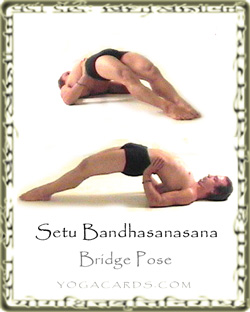
Bridge Pose – Setu Bandhasanasana
Translation: Bridge pose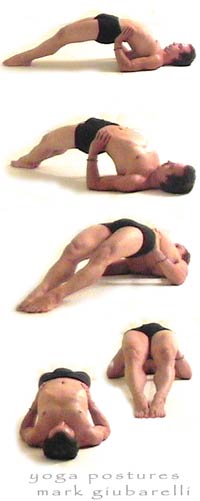
Lying on the back place the hands down on the mat beside the hips.
Bend the knees and take the heels quite close to the buttocks.
Raise the pelvis and chest remaining grounded with the shoulders, neck, head and feet. Place the hands under the lower back for a little extra support.
The easiest way to do this is to place only the thumbs under the back and the hands into the sides of the body. Doing this will allow you to endure this pose for a longer period of time.
Walk the legs out stopping when the big toes struggle to touch the mat. Extend through the inside of the legs and push down on the inside of the feet.
Allow the shoulders to touch the mat.
Do not let the vertebrae in the lower neck touch the mat. Create space around the neck for the elements to flow.
Benefits of Bridge Pose
Deep muscles in the spine are strengthened such as the iliocostal lumborum, longissimus thoracis, iliocostalis thoracisis.
All of the gluteal muscles are strengthened. These are the gluteus maximus, medius and gluteus minimus. The hamstrings are also a major support in this pose these are (the biceps femoris, semitendinosus and the semimembranosus). If the toes touch the mat the muscles around the tibia, and further up the leg the qaudriceps, are also used for support.
Common Faults in Bridge Pose
The legs seem to rotate outwards. This causes the big toes to raise of the mat. The ankles have to be very flexible to get the feet flat on the mat with the legs straight. You may want to allow a slight bend in the legs so that the feet stay flat on the mat. Or you may want to balance the sides of the feet on the mat so that it is easy to straighten the legs. Implementing either technique will allow a greater endurance when performing this posture.
Vinyasa Yoga postures to transition from and to:


Eka Pada Setubandhasana Urdhva Dhanurasana Eka pada Jathara Parivarttanasana Supta Virasana Matsyasana Setu Bandha Sirsasana Bridge On The head Eka pada Jathara Parivarttanasana
Yoga Teacher Tips
This is a very hard posture to perform. Always offer an easier posture of after a while offer a mild variation to relieve any leg strain and discomfort.
“Students can rarely perform backbends for long periods of time or many different backbends in a row without felling discomfort and fatigue. Break up the backbends with lying spinal twists and abdominal strengtheners or something else fitting. The class will flow much better and you will get more out of your students. ”